
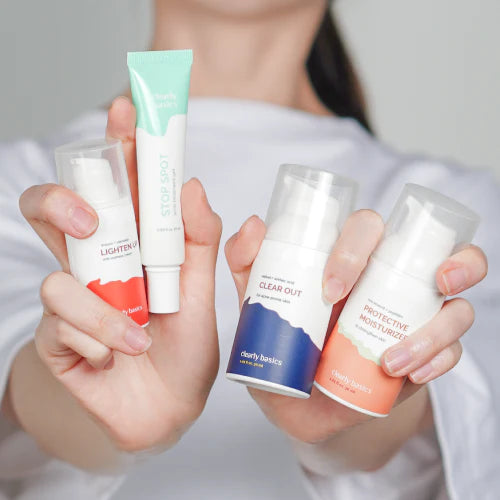



Overwhelmed by complicated skincare routines? Learn how to create a minimalist skincare routine that works for your skin's needs, with strategies from women who simplified their routines and saw dramatic improvements.
If you're reading this, chances are your bathroom looks like a skincare pharmacy. Serums for every concern, treatments for every skin texture issue, and routines that take longer than morning coffee. We've been there.
You probably started with good intentions—researching ingredients, trying the latest "must-have" actives, building what felt like the perfect regimen. But somewhere along the way, your 15-step routine became overwhelming. Your skin became reactive. And you started wondering if all those products were actually helping or making things worse.
The truth? They were probably making things worse.
Why Complex Routines Backfire
When skin is stressed or reactive, the instinct is to add more products. Oil cleanser, gel cleanser, exfoliating toner, niacinamide serum, retinol, three moisturizers. Sound familiar?
Here's what happens: your skin barrier becomes compromised, creating a cycle of irritation. Your skin overproduces oil to compensate for stripping, becomes more sensitive to everything applied, and breakouts increase because the barrier can't protect against environmental stressors.
"I see this pattern constantly," explains Ron Kwok, licensed esthetician and founder of Clearly Basics. "People come to me with cabinets full of products and skin that's more reactive than when they started. The solution isn't another serum—it's strategic simplification."
Your skin barrier thrives on consistency and gentle care, not constant experimentation with new actives.
The Science Behind Simplified Skincare
Research consistently shows that a compromised skin barrier is at the root of most skin concerns. When you disrupt this barrier with too many actives or incompatible ingredients, you're creating the very problems you're trying to solve.
Your skin needs time to process and respond to active ingredients. When you're constantly introducing new products, your skin never gets the chance to show you what's actually working. This is especially true for ingredients like retinol, niacinamide, and acids—all powerful actives that need weeks or months to show their full benefits.
The most effective approach? Focus on barrier repair and targeted treatment. This means choosing fewer products that work synergistically rather than competing for your skin's attention.
The 5 Core Steps of Any Successful Routine

After working with thousands of clients, Ron developed what he calls the "Essential 5" approach—a streamlined routine that addresses your skin's core needs without overwhelming your barrier.
Step One: Gentle, Effective Cleansing
Your skin doesn't need to feel "squeaky clean" to be properly cleansed. In fact, that tight feeling usually means you've stripped away beneficial oils your barrier needs.
Morning: If your skin isn't particularly oily or you didn't use heavy products the night before, a gentle splash of water or micellar water is often enough. Over-cleansing in the morning can disrupt your skin's natural pH balance.
Evening: This is when you need thorough cleansing to remove makeup, sunscreen, and daily buildup. Look for a cleanser that removes impurities without leaving your skin feeling tight or dry.
Our recommendation: Pore Clearing Cleanser uses salicylic acid to gently dissolve buildup while maintaining your skin's natural moisture barrier. Unlike harsh cleansers that strip everything away, this formula cleanses deeply while protecting the beneficial oils your skin needs.
Step Two: Daily Exfoliation and Prep
Regular exfoliation is essential for healthy skin turnover and preventing congestion that leads to breakouts and dull texture. But most exfoliating products are too harsh for daily use, causing irritation that defeats the purpose.
The key is finding an exfoliating toner with the right concentration of acids that can be used consistently without compromising your barrier. This daily prep step removes dead skin cells while preparing your skin to better absorb treatment products.
Our recommendation: Pore Perfecting Toner contains 8% exfoliating acids designed for daily use without irritation. The barrier-repairing base ensures you get effective exfoliation while maintaining skin health—exactly what reactive skin needs to improve without setbacks.
Step Three: Using a Gentle Vitamin A
Vitamin A (retinol) is the gold standard for skin improvement—proven to increase cell turnover, boost collagen production, and improve texture and tone. The challenge is that most retinol products are too irritating for consistent use, especially on reactive skin.
You don't need high concentrations to see results; you need high purity and smart formulation. A gentle, buffered retinol used consistently will outperform a strong retinol that you can only tolerate twice a week.
For breakouts and congestion: Retinol helps normalize cell turnover, preventing pores from becoming clogged.
For texture and tone: Regular retinol use smooths skin texture and improves overall radiance.
For early aging concerns: Retinol stimulates collagen production and accelerates skin renewal.
Our recommendation: Clear Out Skin Clarifying Cream combines pharmaceutical-grade retinol with soothing botanicals to deliver results without irritation. It's formulated specifically for sensitive skin that needs real improvement without the typical retinol side effects.
Step Four: Lock in Hydration
If you could only use one product for the rest of your life, it should be a good moisturizer. This step seals in all the beneficial ingredients from your previous steps while reinforcing your skin barrier.
The key is finding a moisturizer that provides adequate hydration without feeling heavy or contributing to breakouts. Your skin type will determine whether you need something lightweight or more occlusive.
Our recommendation: Intense Barrier Repair Moisturizer is formulated with ceramides and peptides to strengthen your skin barrier while providing long-lasting hydration. It's substantial enough for dry skin but won't clog pores or feel greasy on oily skin types.
Step Five: Protect (Morning Only)
Sunscreen is non-negotiable if you want healthy skin long-term. But it doesn't need to be complicated—you just need something with broad-spectrum protection that you'll actually use every day.
Look for SPF 30 or higher with a texture you enjoy. Chemical sunscreens tend to be more cosmetically elegant, while mineral sunscreens are better for sensitive skin.
Our recommendation: La Roche-Posay Anthelios Sunscreen offers reliable broad-spectrum protection with a lightweight texture that works under makeup. It's dermatologist-tested and gentle enough for reactive skin while providing the protection your routine requires.
Strategic Add-Ons: When You Need More
A simplified routine doesn't mean you can never use other products. It means being strategic about when and how you introduce additional treatments.
Professional Exfoliation
If your daily routine includes gentle acids, you might not need additional exfoliation. But if you're dealing with stubborn texture or dullness, a weekly treatment can help.
Our recommendation: 20% Glycolic Acid Resurfacing Pads provide professional-strength exfoliation in a controlled, easy-to-use format. Use once or twice weekly to reveal smoother, more radiant skin.
Targeted Aging Concerns
Your daily routine should address your primary concerns, but sometimes you need extra support for specific areas like the neck and décolletage.
Our recommendation: Advanced Neck Cream contains peptides and firming ingredients specifically formulated for the delicate neck area. It's designed to work alongside your facial routine without causing sensitivity.
Intensive Hydration Boost
When your skin needs extra moisture—during weather changes, after travel, or during hormonal fluctuations—a weekly mask can provide intensive hydration.
Our recommendation: Hydra-Plump Collagen Renewal Face Mask delivers concentrated hydration and plumping benefits. Use weekly or as needed to restore moisture and improve skin texture.
How to Transition to Your Simplified Routine
Don't try to change everything at once. Your skin needs time to adjust, and you need time to observe how it responds to each change.
Week 1-2: Introduce your new cleanser and moisturizer. These are the foundation products that are least likely to cause reactions.
Week 3-4: Add your toner and observe how your skin responds. You should notice improved texture and better absorption of your moisturizer.
Week 5-6: Introduce your treatment product (retinol, acids, etc.) slowly. Start with 2-3 times per week and gradually increase frequency as your skin tolerates it.
Week 7+: Add any strategic treatments like weekly exfoliation or targeted serums, but only after your skin has adjusted to the core routine.
What to Expect
The first few weeks might feel strange—you're probably used to that "loaded up" feeling of multiple products. But within 2-4 weeks, most people notice:
-
Reduced irritation and redness
-
More balanced oil production
-
Improved product absorption
-
Clearer, smoother texture
-
Less reactive skin overall
"The biggest transformation I see," Ron notes, "is when people stop chasing every new ingredient and start focusing on what their skin actually needs. That's when real, lasting improvement happens."
The Bottom Line
Effective skincare isn't about having the most products or newest ingredients—it's about understanding your skin's needs and providing consistent, targeted care that supports your natural barrier function. Your routine should feel sustainable, not stressful, addressing your primary concerns without creating new ones.
Remember: healthy skin is a marathon, not a sprint. The routine you can stick with consistently will always outperform the perfect routine you abandon after two weeks.


